Auto industry
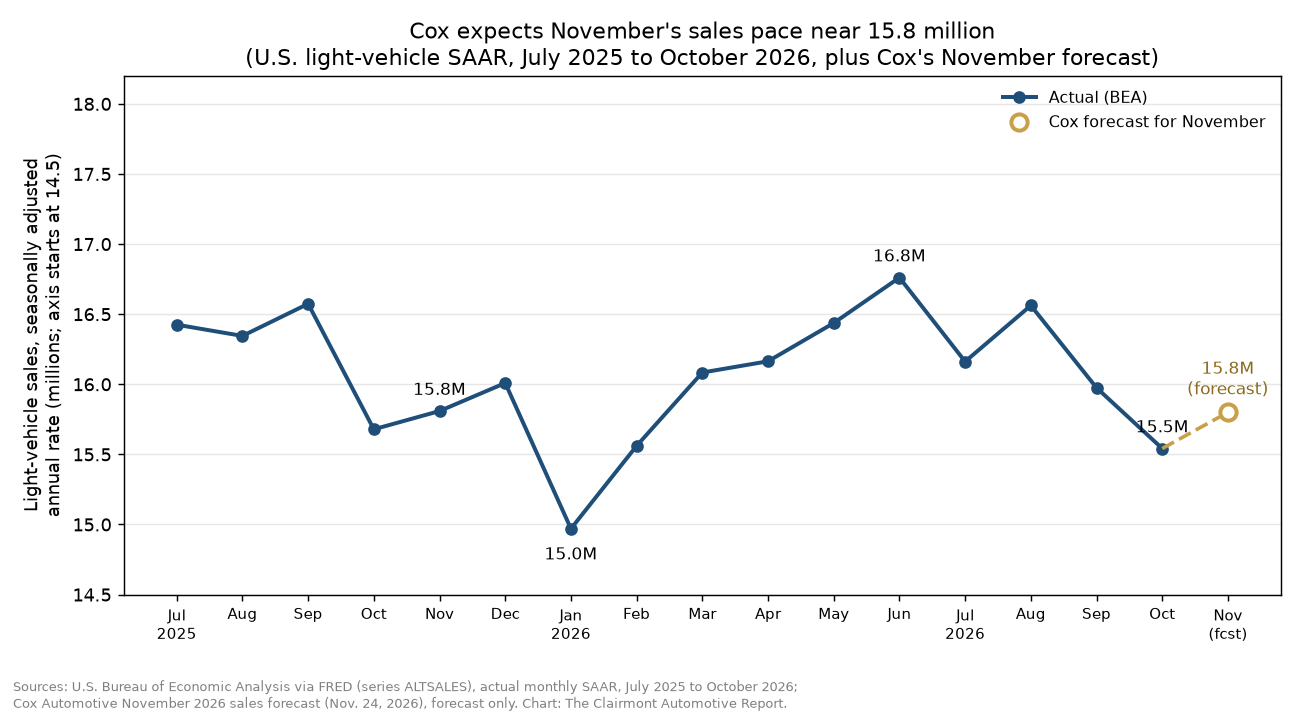
Cox sees November's sales pace near 15.8 million
Cox Automotive expects November's seasonally adjusted selling rate to finish near 15.8 million, up from 15.5 million in October (the figure we reported Nov. 10) and level with November 2025, according to its Nov. 24 forecast. Raw volume is expected at about 1.20 million, down 10.3% from October and 7.3% from a year earlier, mostly because November has 23 selling days, five fewer than October and two fewer than last November. Per selling day, sales are running about 1% ahead of last year. Cox says lower gas prices could help over the holiday weekend, but with loan rates rising and payments high, it expects sales to hold steady rather than surge through year-end.
Possible industry effect: Because the drop in volume comes from the calendar more than from demand, stores comparing November with last year may want to look at per-day sales before judging the month, and payment-focused deal structure is likely to matter more than price alone. Link
The other stories from Wednesday, November 25, 2026.
Holiday discounts widen to 6.8% below sticker
TrueCar data reported by CDG News shows the average new vehicle selling 6.8% below MSRP heading into Thanksgiving, up from 6.1% a year ago.
Read the full summary →
Ineos plans U.S. production from 2028
Ineos has shortlisted U.S. sites to build the Grenadier and Quartermaster and aims to start production in 2028.
Read the full summary →
Ford confirms Pentagon talks on military vehicles
Ford says it has talked with the Pentagon about military vehicles and other defense products. No contract has been announced.
Read the full summary →
Update: Car-Mart files for Chapter 11 with a buyer lined up
Car-Mart filed a prepackaged Chapter 11 with a deal to sell substantially all its assets to Cardinal Asset Holdings, which would take on its service-contract obligations.
Read the full summary →
F&I income per deal holds near highs as products per deal slip
StoneEagleDATA puts third-quarter F&I profit per vehicle at $1,975, up 2.3%, while products per deal slipped to 1.52 and GAP penetration rose to 39%.
Read the full summary →